

When I was in the U.S. Air Force, one lesson got drilled into me fast: if a group wants to survive chaos and function under pressure, it needs an emergency action plan.
That sounds obvious in military spaces, but it barely exists in civilian life.
Most people have never been taught how dependent modern life is on systems they don’t control. Like power, water, communications, payments, logistics, medical care, and food distribution. We rely on all of it every day, and most of us assume it’ll always be there. But when networks become targets, the damage won’t stay inside a screen. It ripples outward into the infrastructure that holds daily life together.
I hope this guide is something you never need. The point is that complex systems can fail anywhere, and everyone deserves a clear plan to follow if they do.
That’s the gap this guide is meant to close.
Get the 90+ page Community Emergency Action Plan Guide here
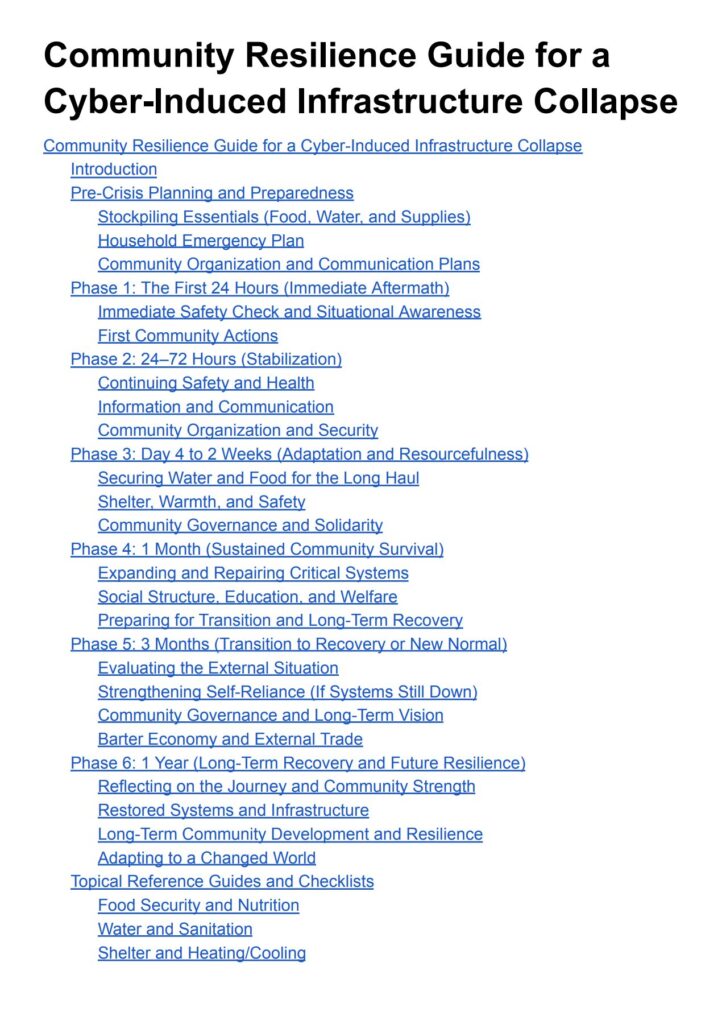
I put this together to distill practical lessons from my military training into something civilians can actually use. It’s a real-world resource for thinking clearly, planning ahead, and getting your bearings if the systems we rely on fail all at once.
I strongly recommend printing this document and keeping a hard copy.
If communications go down, cloud access won’t help you. Neither will a bookmarked tab or saved post. Paper does.
I also highly recommend checking out my guide on Meshtastic for off-grid texting communications. I ESPECIALLY recommend scrolling to Part 2: Family Emergency Action Communication Plans for Comms-Out Situations.
What keeps people alive in real crises is not blind faith in institutions or some lone-wolf survival myth. It is community, neighbors, and people who know each other, trust each other, and act before fear turns everyone inward.
We’ve been trained by modern life to stay isolated, suspicious, and dependent. That makes us brittle.
But reality keeps showing us something better. After Hurricane Helene in Western North Carolina, communities stepped up. People checked on each other. Shared supplies. Cleared roads. Passed information. Filled the gaps before official systems could catch up. That’s how survival works in the real world. The community protects itself. Look for the helpers, then become one.
We are strongest when we come together as decentralized communities built around competence, mutual aid, and the greater good.
The world is moving faster than most people realize. The systems around us are more interconnected, and more fragile, than they appear. That doesn’t mean despair. Instead, we must focus on preparation. It means taking resilience seriously before you are forced to.
My hope is that this guide helps you think more clearly, plan more intentionally, and feel less helpless in the face of uncertainty.
If the worst case ever comes, communities will be the backbone of survival long after centralized systems stop showing up.
And that means preparedness surpasses the personal; it’s communal.